A maximum of two tickets per person may be collected from the box office up to 48 hours prior to the performance.
Commemoration of Commander’s Day
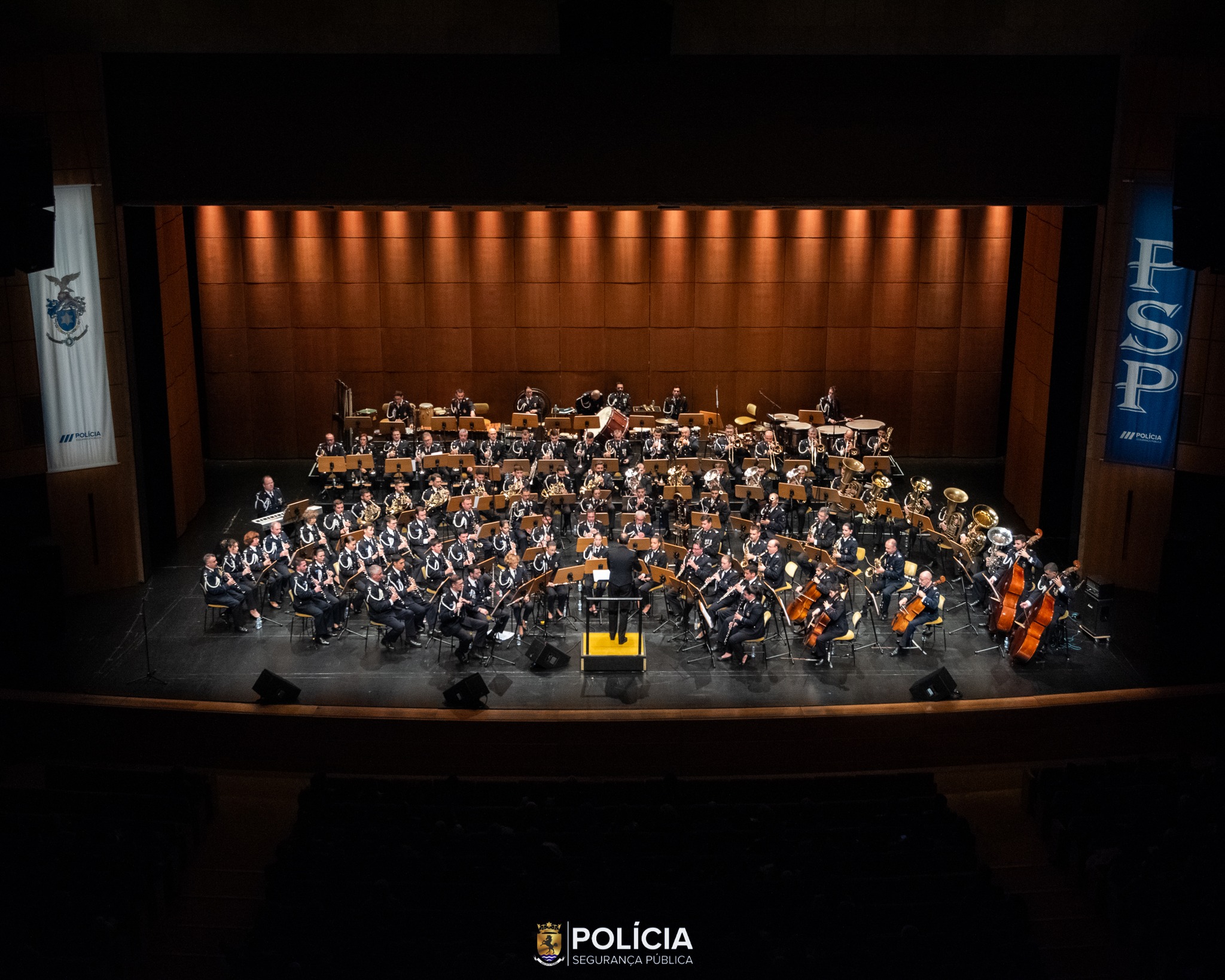
Symphonic Band of the Public Security Police
The Symphonic Band of the Public Security Police (PSP), as an integral unit of the PSP, traces its historical origins to the creation of a police force in Portugal.
While the first body of police officers, known as the Quadrilheiros, was established by King Ferdinand I in 1383, the origins of the PSP Symphonic Band date back a further four and a half centuries.
Throughout the history of Portuguese policing, and in response to the need to maintain public order and security, numerous laws and decrees created, abolished and reorganised police institutions.
Under the leadership of Pina Manique, the General Police Intendancy gained public recognition for its efforts in combating crime. As a result of the reorganisation of police services, the Royal Police Guard (Guarda Real de Polícia) was established on 25 December 1801. This institution included within its ranks the first military-style band in Portugal.
From that date onwards, many military institutions adopted the model of the Royal Police Guard Band. As noted by Albino Lapa, it was “the first armed military organisation established to maintain public security” and, given its prestige, “could not do without a music band,” headquartered at Costa do Castelo in Lisbon. It is therefore evident that this model originated within a policing context dedicated to maintaining public order and peace. For this reason, the PSP Symphonic Band rightfully claims the historical legacy of the Royal Police Guard Band.
Over the years, political circumstances and changing needs led to successive reforms of Portugal’s police forces. Some organisations disappeared, others were created, and several coexisted simultaneously.
The passage of time witnessed the creation and dissolution of the National Guard (1823, associated with the Liberal movement), the Municipal Guards of Porto and Lisbon (1834, the latter being the last force to surrender to Republican forces), and eventually the Civil Police Corps, created by King Luís I on 2 July 1867. This institution laid the foundations for the present-day Public Security Police.
Within this intricate network of police organisations, all sharing similar objectives despite their structural differences, music remained a constant presence. In 1925, Captain José Esteves Graça, then serving with the Civic Police of Lisbon, took charge of a group of musicians from the institution, thereby forming the Music Band of the Lisbon Civic Police Corps.
In 1927, the Lisbon Civic Police adopted the name Public Security Police (PSP), and the band has remained part of the organisation ever since.
Between 1927 and 1950, under the direction of Captain Armando Fernandes, the Band significantly enhanced its artistic standards, culminating in its achievement of first prize in the Military March Competition organised by the National Broadcasting Service in 1936.
Between 1959 and 1969, the Band’s artistic direction was entrusted to Second Lieutenant Álvaro Sousa, who was succeeded by Captain Pinto Rodrigues. He remained in office until 1979, when Major Silvério Campos took command, ushering in a new historical, artistic and institutional era for the PSP Symphonic Band.
On 28 April 1981, through Decree-Law No. 88/81, the PSP Symphonic Band was officially established. Its permanent operational regulations were subsequently defined through internal directives published in PSP General Orders No. 129 (Part I) of 10 August 1982 and, more recently, by Ordinance No. 290/201.
As a symphonic ensemble, the Band steadily gained institutional recognition. This was reflected in commendations awarded by Commander-General General Monteiro Pereira on 7 July 1994, by His Excellency the President of the Republic, Dr Jorge Sampaio, on 29 November 1996, and in further commendations granted by senior PSP leadership in 1996, 1997, 2013 and 2015. Such recognition has also been earned through its artistic success and performances on prestigious stages in Portugal and abroad.
During the celebrations marking the 128th anniversary of the International Red Cross, the Band was awarded a diploma and medal of appreciation for its “spontaneous and valuable cooperation”. It has also been recognised as an Honorary Benefactor of the Hospitaller Order in Portugal and of the Cultural Celebrations of the Fifth Centenary of the Birth of Saint John of God. On 23 January 2025, it was awarded the Gold Grade Medal of Police Merit and Valour.
Internationally, the Band represented both Portugal and the PSP at the 7th International Band Festival in Saumur, France, in 1997. In 2000, it participated by invitation in the 5th International Band Festival in Saint-Étienne, performing before an audience of music enthusiasts who filled the Massenet Theatre.
Since its official establishment, the conductors of the PSP Symphonic Band have been Major Silvério Campos, Superintendent Ernesto Esteves and Sub-Commissioner Alberto de Freitas.
Young in spirit but rich in heritage, the PSP Symphonic Band has consistently occupied a pioneering position within Portuguese artistic movements.
It was the first band within Portugal’s military and security forces to include female musicians among its members.
Its close relationship with society and academic institutions has enabled it to lead numerous innovative initiatives throughout its history. It was a pioneer in regularly recording audio productions for both national and international labels; in presenting concerts featuring renowned Portuguese and international soloists; in inviting nationally and internationally acclaimed conductors to lead performances; in collaborating with academies and universities in band conducting programmes; in mentoring conducting students and participating in thesis examinations; in commissioning works from young composers; and in collaborating with musicians and artists from diverse musical genres ranging from Fado and Jazz to Rock.
Among its highlights are the 2005 concert at the Olga Cadaval Theatre in Sintra, where it performed alongside Maria João and Mário Laginha, and its collaboration with the Portuguese Saxophone Association during the first and subsequent congresses dedicated to the instrument, accompanying some of the world's leading saxophone soloists.
In July 2012, it organised, for the first time worldwide, the 1st Academic Master Class Week in Conducting and Performance, enabling students from artistic education institutions to work at the highest level within a professional musical ensemble, culminating in a public concert.
For several years, the Band has maintained an active Brass Ensemble, performing in a wide variety of official ceremonies and public events for audiences of all ages. It also promotes the “Concertos de Palmo & Meio®” series, aimed at children between six months and six years of age.
The Chamber Trio and the Wind Quintet regularly participate in official ceremonies in collaboration with the Presidency of the Republic and the Ministry of Foreign Affairs. The Band also includes a Piano and Voice Duo, which performs at a broad range of events, and more recently established the PSP Symphonic Band POP Trio, dedicated to repertoire influenced by jazz and light music.
The Band has recorded 21 CDs for the Dutch label Molenaar.
Despite the constraints inherent to the realities in which it operates, the PSP Symphonic Band is composed of highly qualified musicians with distinguished artistic, academic and professional backgrounds. Under the leadership of its current Acting Head and Artistic Director, Chief Superintendent Ferreira Brito, assisted by Sub-Commissioner Pedro Ferreira and Chief Inspector Rui Rocha as Deputy Bandmaster, it continues its mission of serving both the Public Security Police and Portugal.